
On Sunday, February 22, as part of BC Heritage Week, the Archives will be participating in the Vancouver Heritage Foundation’s 9th annual Community Fair at Heritage Hall. The theme for this year is ‘Stir the Pot’. With that in mind, we thought it a great excuse to have a look at some of the culinary records in our holdings and to have fun in our own kitchens creating some of these recipes, while reflecting on how ‘food connects with memory, advocacy and meaning’.
This post documents Archival Assistant Bronwyn’s experiment.
How many eggs?!
Our social media theme back in November 2022 was centered around food – menus and recipes from our holdings. That is when I first came across the recipe for ‘spunge cacke’ from the Goepel family fonds. The fonds itself is small, boasting of only one folder, and containing mainly family records related to land and financial matters dating 1811-1875. But there are also a few (in my opinion) more interesting records, like this page of recipes.
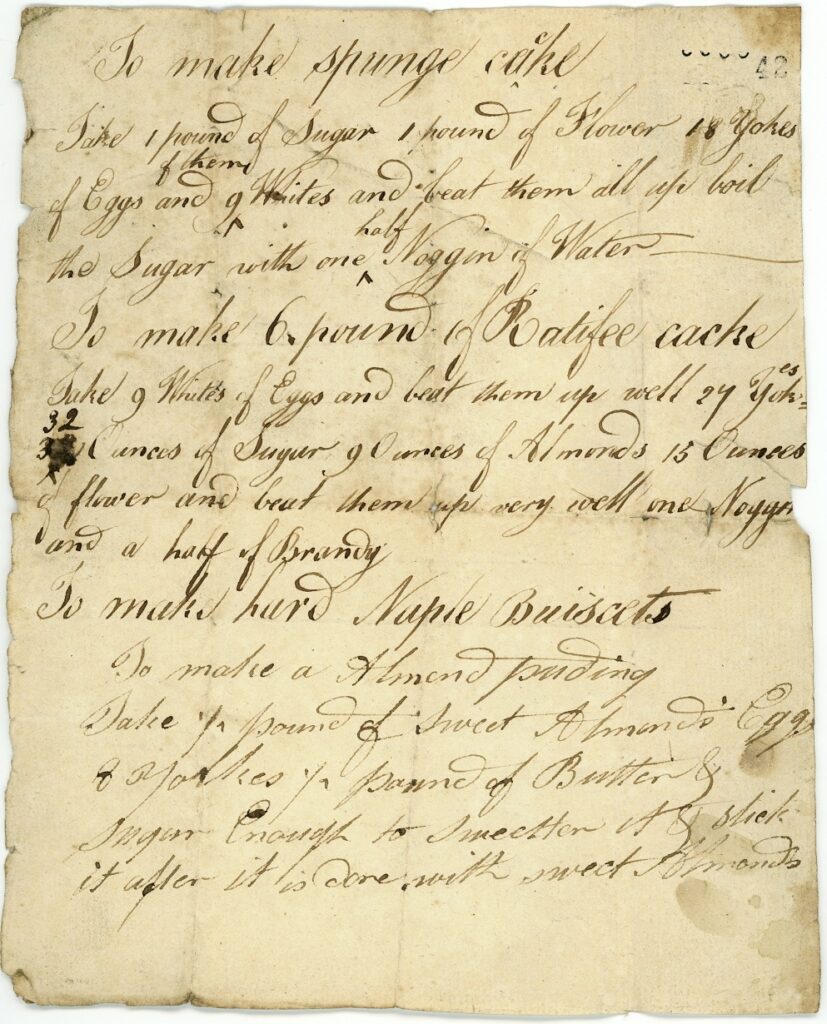
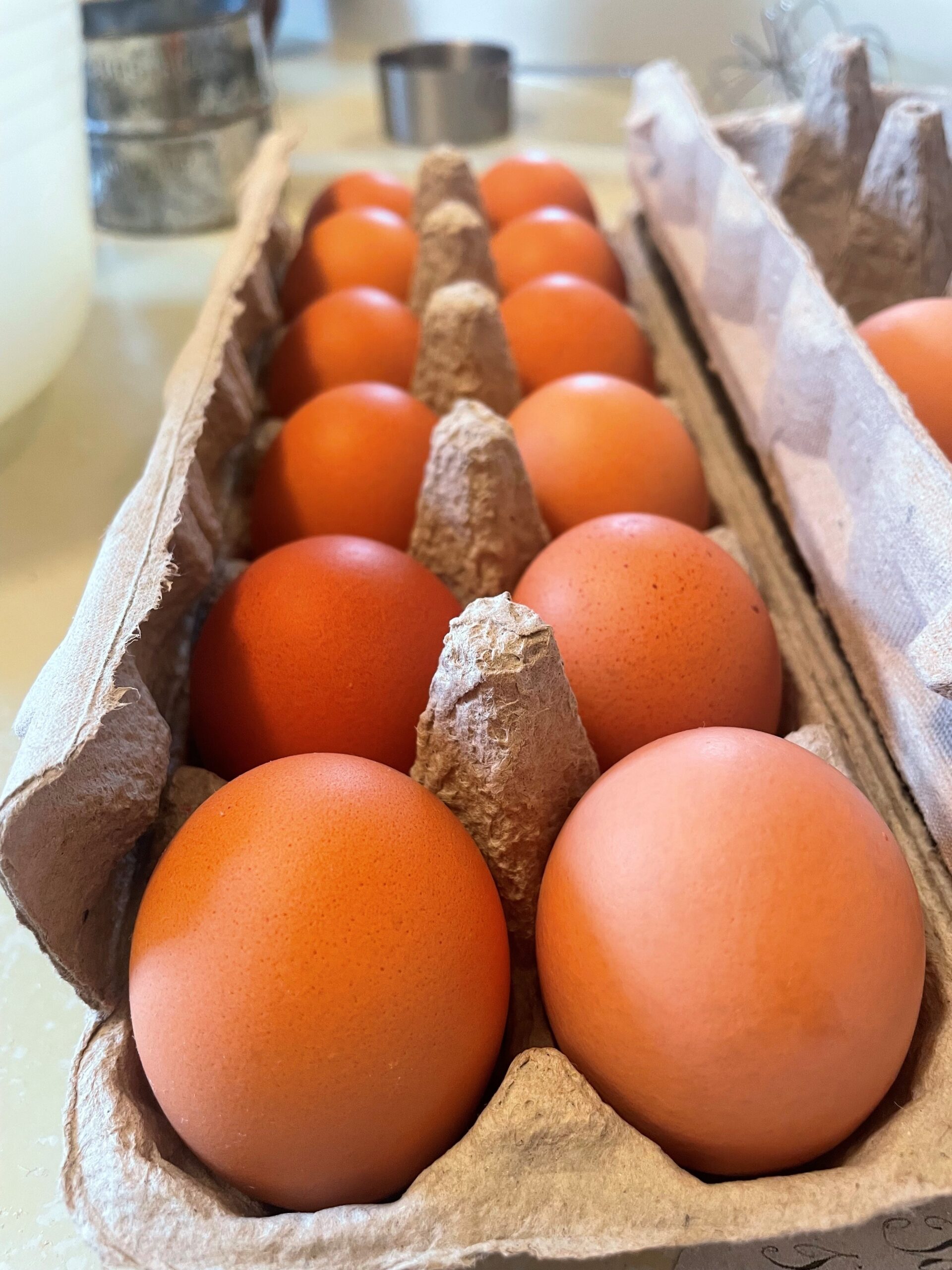
The first thing that struck me about the recipes written on this piece of paper (other than the gorgeous handwriting) was how many eggs it calls for – 18 yokes for the spunge cacke, and 27 for the Ratifee cacke! That’s a lot of eggs! That combined with the lack of detail on mixing and baking methods, and reference to ‘one half Noggin of Water’ and ‘one Noggin and a half of Brandy’ (what the heck is a noggin, other than a reference to someone’s head?), put me off from trying these recipes. Afterall, if I didn’t crack (pun intended) how to properly mix and bake these batters, I was risking a lot of ingredients potentially going to waste.
The desire to give this recipe a go, despite my misgivings, has badgered me for the last two years, so I finally decided to transcribe the recipe (see below), do a bit more research into unpacking unfamiliar words, and compare the recipes with recipes published around the same time to glean methods, and also to compare whether the call for the large number of eggs was indeed reasonable!
The sheet contains three complete recipes and only the title of a fourth. The final recipe on the page looks as if it were added later, given the differences in ink between the top recipes, and that it appears to be indented, unlike the previous recipes. Though the ingredients for the Naples buiscets [biscuits] are absent, I was able to find a description of what they may have contained and how to make them in The cook’s dictionary and house-keeper’s directory: A new family manual or cookery and confectionery, on a plan of ready reference never hitherto attempted by Richard Dolby, published in 1830. The publication says, ‘Put three quarters of a pound of fine flour to a pound of fine sifted sugar; sift both together three times, then add six eggs beaten well, and a spoonful of rose-water; when the oven is nearly hot, bake them, but not too wet.’
Back to the complete recipes. I established (thanks to my Oxford English Dictionary sitting next to my computer) that a noggin is a ‘small mug; small measure usu. ¼ pint, of liquor’. I was also unfamiliar with the term ‘Ratifee’ and once again the dictionary proved useful, defining Ratifee (or Ratafia or Ratafee) as a ‘liquor flavoured with almonds or kernels of peach, apricot or cherry; kind of biscuit similarly flavoured; kind of cherry.’ Makes sense given the ingredients listed.
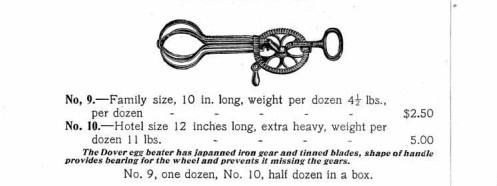
Then, on a gloomy, chilly January, I gathered my ingredients and began my experiment. To further reduce the risk of an utter disaster and kissing 45 eggs goodbye, I decided to half the sponge cake recipe, and reduce the Ratifee cake quantities to a third. I did start beating the eggs with my rotary whisk (an invention of the 1800s), but soon gave up. Though it gives a greater mechanical advantage to beating or whipping than a standard hand whisk through its use of gears, it still takes a good amount of work. All I can say is that baking back in the 1800s certainly took a lot more effort, and perhaps meant that you never needed to go to the gym!
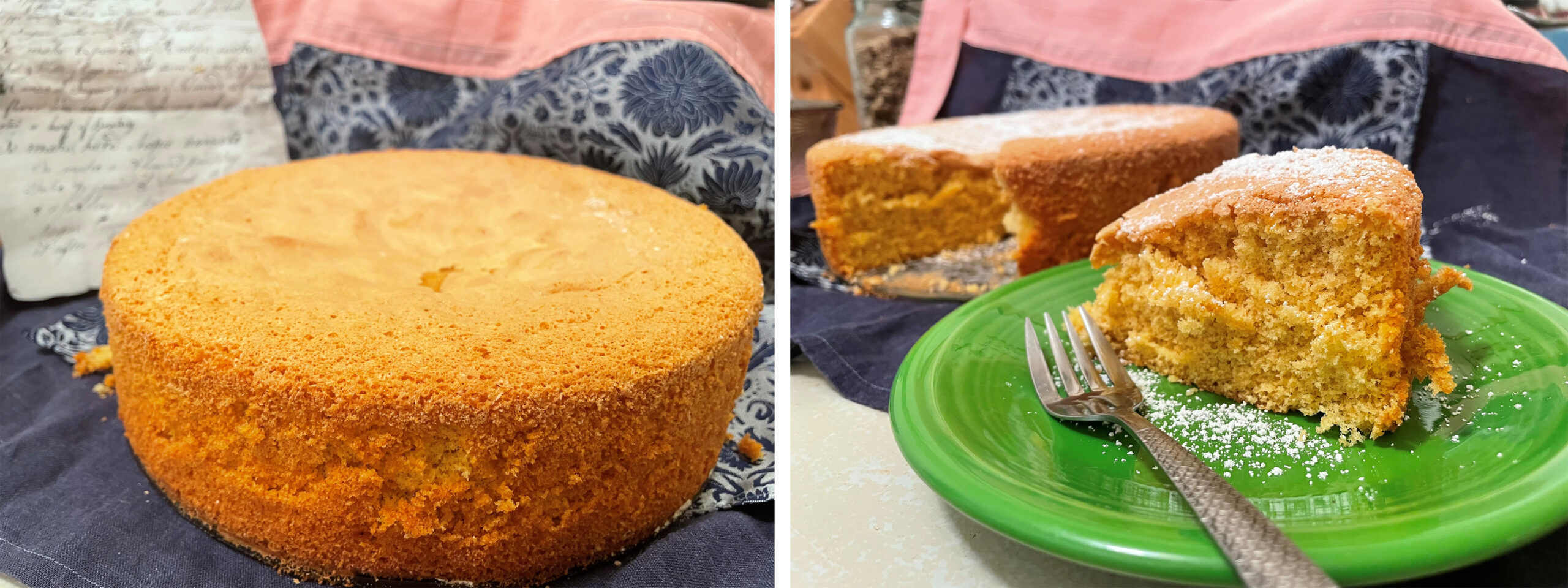
In the end how did the experiment turn out? I think better than expected. The spunge cacke is rather egg-forward in flavour, but smothered with whipped cream and jam, the egg taste disappears. I would say the Ratifee cacke was more to my liking, the almonds giving a more complex flavour and nicer chew. It though, also benefited from the cream and jam.
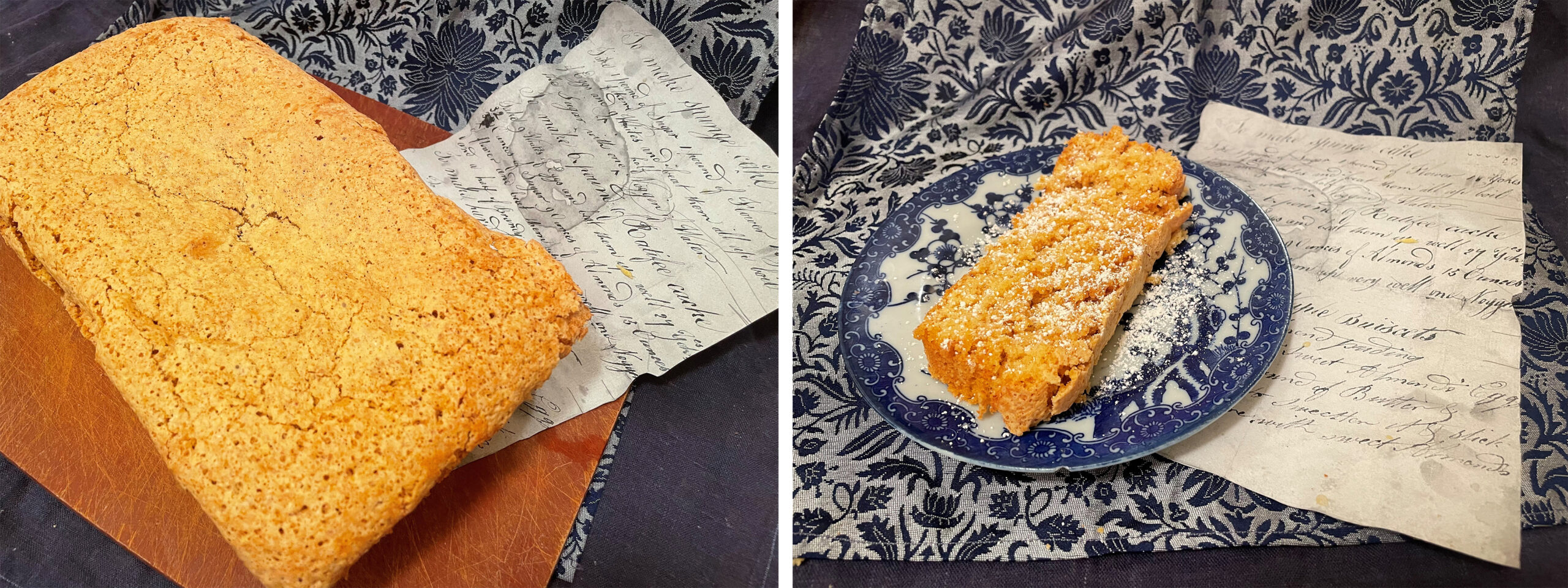
I ran out of eggs before I could give the last recipe a go, so what the almond pudding is like, I have yet to find out. If you feel inspired to try, or to try making the other two recipes, please let us know how it goes! And for your benefit, below is a transcription of the original recipe, and an annotated transcription with updated spellings and the methods I used added in square brackets.
Recipe transcription
To make spunge cacke
Take 1 pound of sugar 1 pound of Flower 18 yokes of Eggs and 9 of them Whites and beat them all up boil the Sugar with one half Noggin of Water
To make 8 pound of Ratifee cacke
Take 9 Whites of Eggs and beat them up well 27 yokes 32 Ounces of Sugar 9 Ounces of Almonds 15 Ounces of flower and beat them up very well one Noggin and a half of Brandy
To make hard Naple Buiscets
To make a Almond puding
Take ½ pound of sweet Almonds Egg & yokes ½ pound of Butter & Sugar Enough to sweetten it & stick it after it is done with sweet Almonds
Annotated recipe transcription
To make spunge [sponge] cacke [cake][1]
Take 1 pound of sugar[,] 1 pound of Flower [flour] [,] 18 yokes of Eggs and 9 of them Whites and beat them all up[.] boil the Sugar with one half Noggin of Water [I believe this part of the recipe may be an icing recipe. I did not try doing this, and opted for whipped cream and jam instead]
[Method:
- Beat the egg yokes and egg whites with an electric mixer for 12-18 minutes
- Add the sugar gradually and beat until well combined
- Sift in the flour, and fold to incorporate into the egg-sugar mixture
- Pour batter into a 9” greased springform pan and bake at 350F for 20-25 minutes, or until centre springs back when touched
- Allow to cool before placing whipped cream and jam on cake]
To make 8 pound of Ratifee cacke [cake][2]
Take 9 Whites of Eggs and beat them up well[.] 27 yokes[,] 32 Ounces of Sugar[,] 9 Ounces of [ground] Almonds[,] 15 Ounces of flower [flour] and beat them up very well[.] one Noggin and a half [3/4 cup] of Brandy
[Method:
- Whisk the egg whites until stiff peaks form
- In a separate bowl, beat the egg yokes and sugar together
- Fold in the egg-sugar mixture into the egg whites
- Sift the flour and almonds together and fold two-thirds into the egg mixture.
- Fold in the brandy, and the remaining flour-almond mixture
- Pour batter into a 9” greased springform pan and bake at 350F for 20-25 minutes, or until centre springs back when touched
- Allow to cool before placing whipped cream and jam on cake]
To make hard Naple Buiscets [biscuits]
[The recipe for these biscuits never made it to the page.]
To make a[n] Almond puding [pudding]
Take ½ pound of sweet Almonds[,] [1/2 pound?] Egg & yokes[,] ½ pound of Butter & Sugar[,] Enough to sweetten [sweeten] it & stick it after it is done with sweet Almonds
Stay tuned for more kitchen experiments in Part 2!
[1] Methods derived from Seventy-five receipts for pastry, cakes, and sweetmeats by a Lady of Philadelphia (Boston: Munroe and Francis, 1830), p. 51-52; and 1800s Scotch Diet Cake Recipe – Not what you think it is…by Glen And Friends Cooking. For more links to 18th and 19th century digitized cookbooks, visit https://savoringthepast.net/2014/08/28/18th-and-early-19th-century-cookbooks-digital-searchable-and-free/
[2] Ratifee, Ratafia, or Ratafee is defined by The Concise Oxford Dictionary as “Liqueur flavoured with almonds or kernels of peach, apricot, or cherry; kind of biscuit similarly flavoured; kind of cherry.”