With Remembrance Day this week, we thought it appropriate to dig into the history of two of Vancouver’s war memorials, namely the Japanese War Memorial in Stanley Park and the Cenotaph War Memorial in Victory Square.
Japanese War Memorial
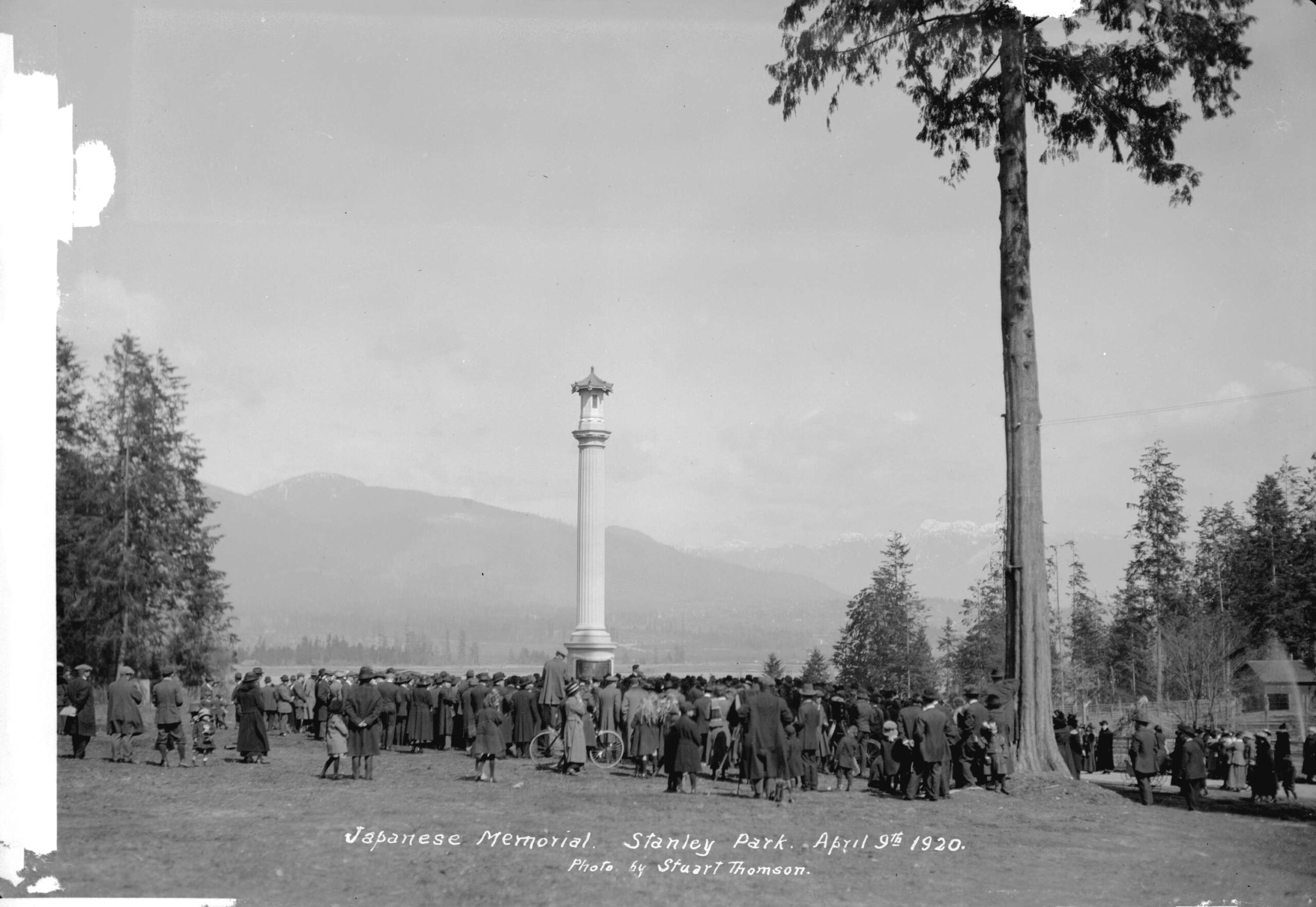
During World War I, the Canadian Japanese Association funded the training of around 200 volunteers from the Japanese community who enlisted in the Canadian Expeditionary Force. To honour those who fought, including the 54 individuals who died while serving in France, the Association decided to erect a war memorial. They sent a letter to the Park Board in July 1919, requesting the use of one of two sites in Stanely Park for this purpose. The Park Board supported the idea, and by October an agreement between the two parties was reached. The Park Board provided the site and labour for preparing it, while the Association paid for the labour, materials and the design by James A. Benzie, architect.
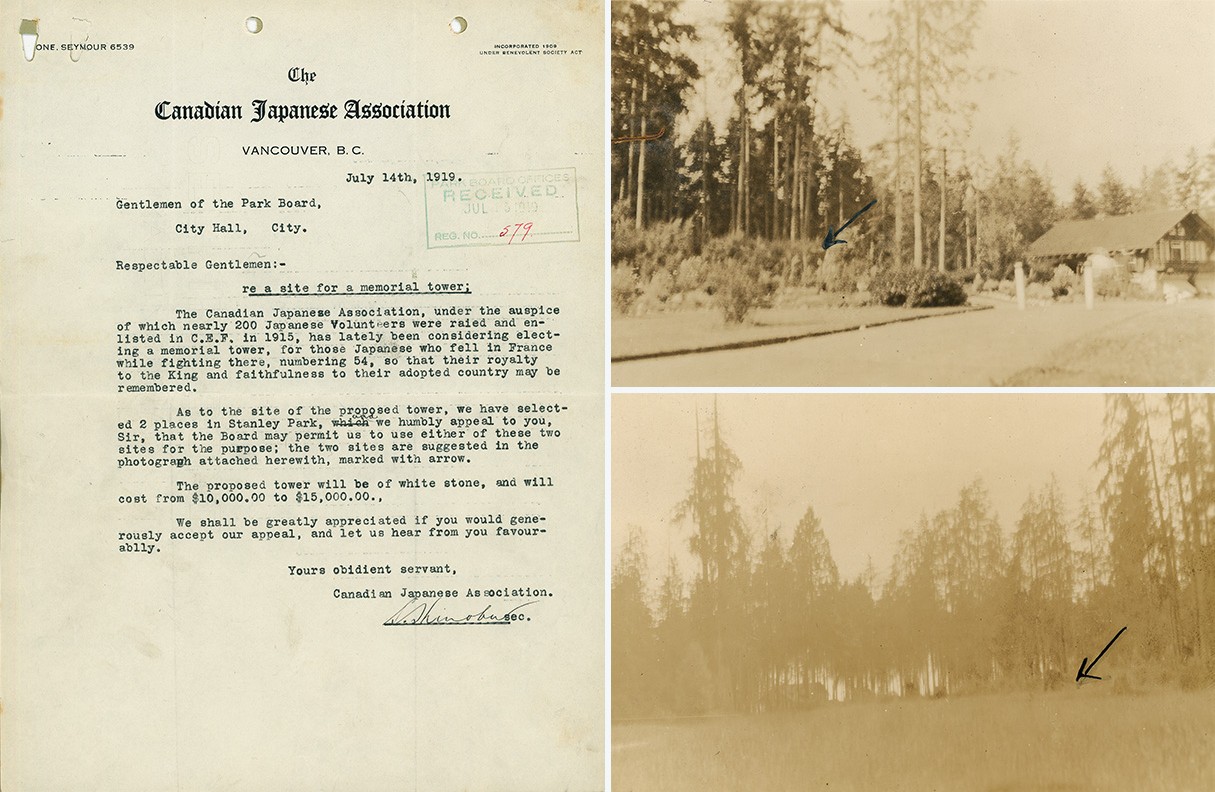
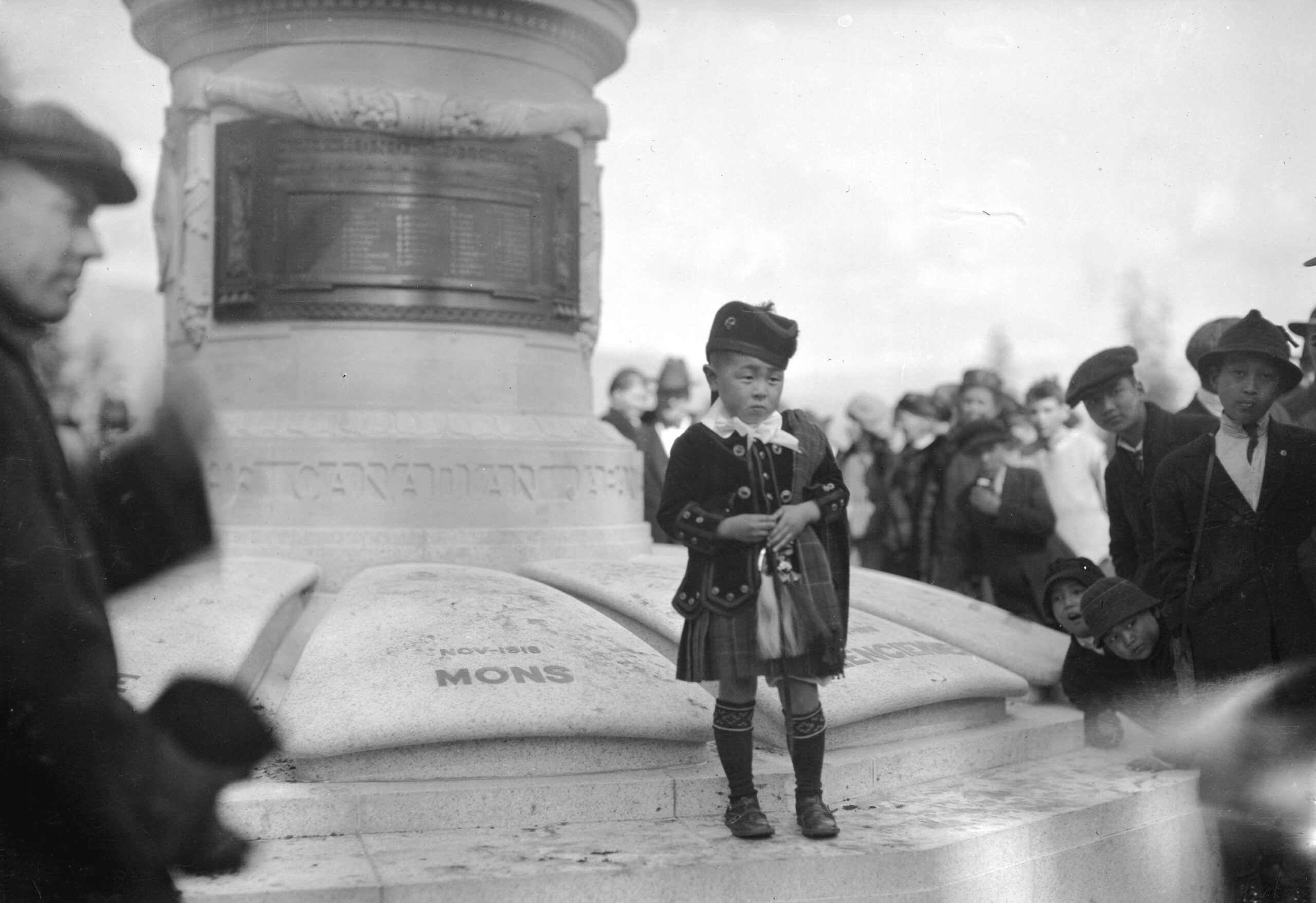
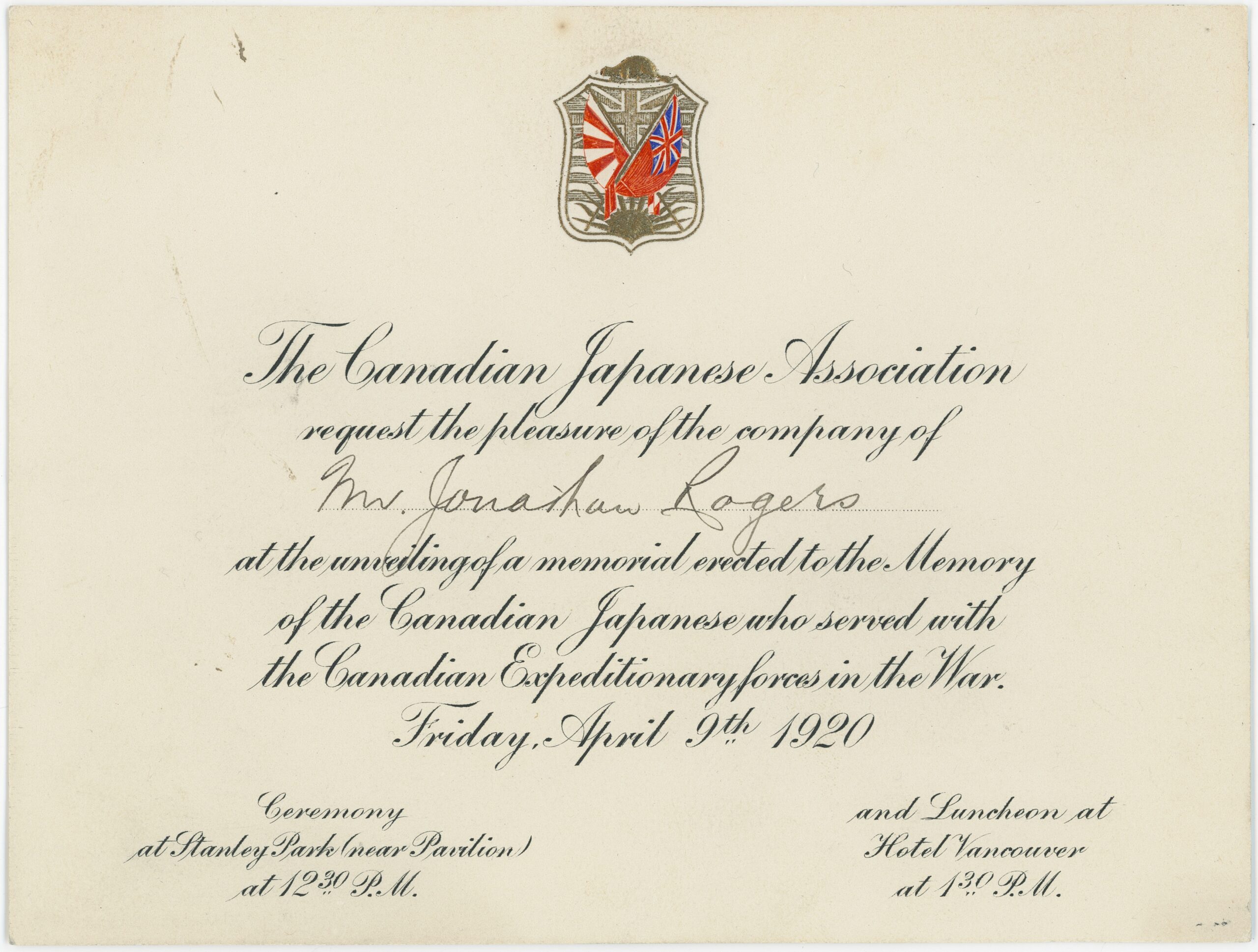
The monument was unveiled on April 9, 1920 with Matamoshin Abe, President of the Association, acting as Master of Ceremonies, and Alderman J.J. McRae officiating, representing the City on behalf of the Mayor, who was unable to attend.
War memorial in Victory Square
In contrast to the Japanese War Memorial, sorting the details of a general city-wide war memorial was relatively slow, stalling throughout the process over differences of opinion and funding challenges. Though many had expressed a desire for a city war memorial before the First World War even ended, it was not until October 1919 that the City formed the Civic War Memorial Committee. The Committee consisted of members of City Council and members drawn from various groups wishing to erect a memorial, most notably those from the Canadian Club.[1]
The Committee met several times over the next two years, but only marginal progress was made, largely a result of the general depressed economic state of Vancouver. A report delivered by Past President of the Club, Robert S. Somerville on October 31, 1921, summed up the Committee’s feeling that ‘so much unemployment and so many other calls on the generosity of the citizens the time is not yet opportune for calling on the citizens of Vancouver to contribute for comparatively large sum that would be needed to erect a memorial worthy of the City.’[2] He added that the Committee hoped the situation would change by the spring, allowing it to launch a funding campaign and begin tangibly realising the memorial.
Somerville also reported on the discussions regarding the form the memorial should take, which ranged from a simple monument to an armoury for Boy Scouts.[3] Sites were also proposed, including the entrance to Stanley Park, Brockton Point, Little Mountain (present day Queen Elizabeth Park), Victory Square (also known as the Old Courthouse Site), and Strathcona Park (present day site of City Hall).
Despite the discussions, progress on the memorial continued slowly, resulting in mounting frustration, particularly amongst members of the Canadian Club, who frequently pointed out that the Japanese community had managed to erect a war memorial in very little time. In February 1922, the President of the Club, Bishop Adam DePencier appeared before the City’s Board of Works to propose a similar arrangement to that of the Canadian Japanese Association–erecting a cenotaph structure at the Club’s expense, but on a City site. The area suggested was at Georgia Street east of Granville Street because it was an area ‘where there was a large volume of traffic and it would always be prominent’.[4] The initial designs presented to the Board were sketched by G.L. Thornton Sharp, architect.[5] The Board approved, but when the plan was passed to City Council to ratify, it was struck down.[6] Brigadier General Victor W. Odlum, Chairman of the Civic War Memorial Committee, was reported in the Vancouver Sun to be of the opinion that this proposal was a ‘minor memorial’ that would take away from securing funding for a ‘more suitable civic memorial’ in the future.[7] He also argued against it on the basis that Vancouver was still facing challenging economic times.[8] There was also mounting disapproval from citizens on the selected site. Many felt that given the area was already very busy, the erection of a memorial would exacerbate the traffic issues, as people would likely be pausing to look at and spend time at the memorial.[9] This amounted to plans once again being delayed.
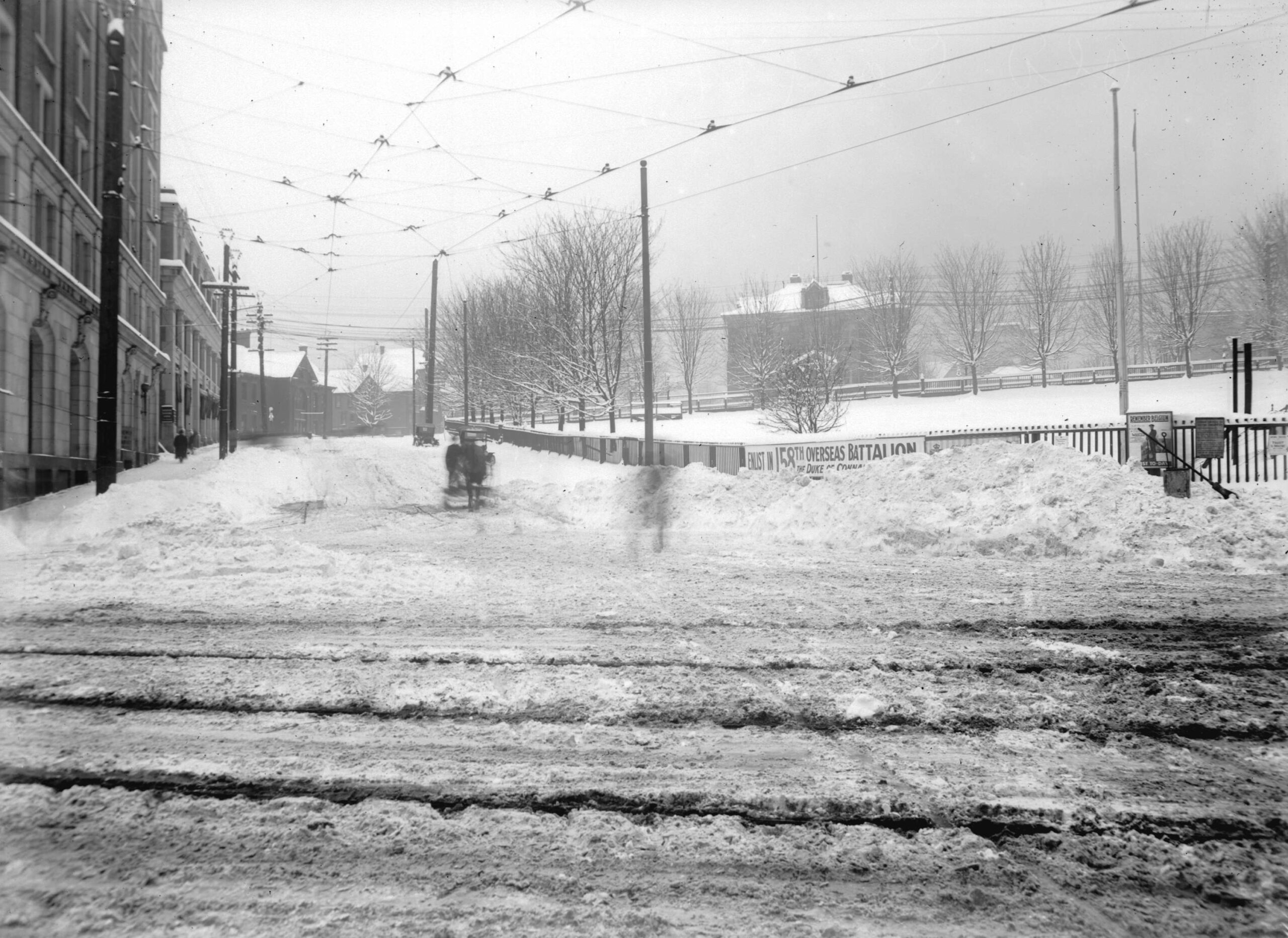
By November, members of the Canadian Club were frustrated enough with the lack of progress that they sent a deputation to Council. The representatives told Council that, if the Civic War Memorial Committee was not prepared to go ahead with the memorial, the Club would be willing to build it as purely a Canadian Club-funded memorial at Victory Square, and presented a new sketch of the plan by Sharp.[10] Council recommended that the location as suggested be approved provided no legal issues arose.[11] The City, in a similar manner to the Japanese War Memorial, provided a certain amount of money to prepare the site, while the cost of the war memorial was paid through fundraising efforts directed by the Canadian Club.
The Canadian Club exhibited Sharp’s sketch designs to its members on February 13, 1923. Over the next few days, the newspapers reported that a decision had not yet been made on the type of memorial and its design, that design submissions were welcome, and that the Committee hoped that a local designer would send in a successful proposal.[12] A design competition was formally announced in the Vancouver Daily World March 2, 1923 issue in the form of a 9-line notice asking for submission designs by BC architects and artists.
On March 12, the Committee re-convened to review the sketches and models received. The minutes do not list who entered the competition, but only that the designs of ‘Mr. Watson of the Credit Foncier Building and Mr. Sharp of Sharp and Thompson drew the most consideration.’[13] After discussion, it was moved that Sharp’s design was the winner. Sharp’s design drawings are part of the Canadian Architectural Archives at the University of Calgary.
Though Sharp’s design was adopted and built, the Archives has a photographic copy of an alternate vision from Fred L. Townley, the architect who eventually went on to design Vancouver’s current City Hall in the 1930s. Townley’s design was far grander in scope than Sharp’s, involving a museum to house war trophies.
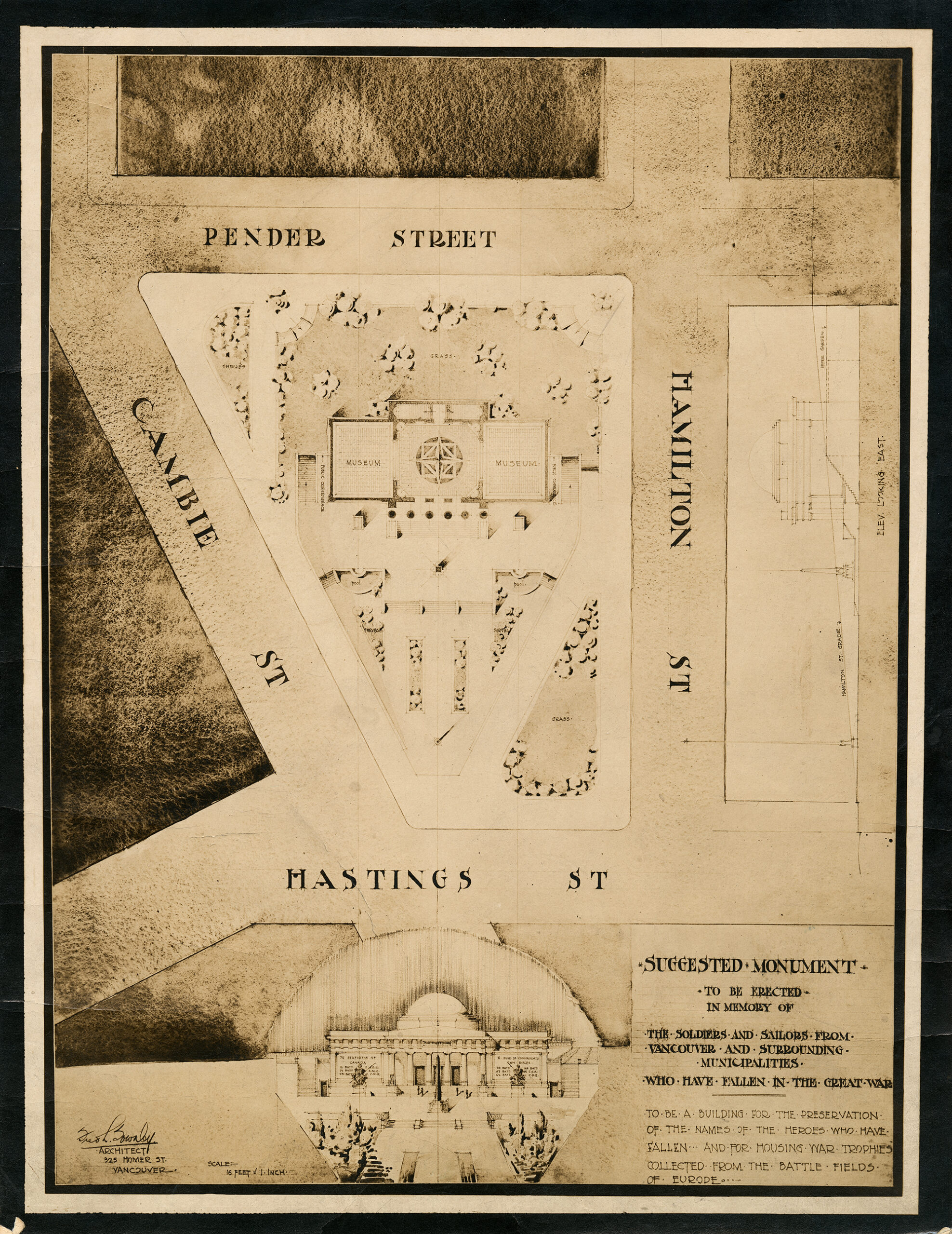
There was some question at the time as to whether this was a fair competition, as suggested in part by two letters to the editor of the Vancouver Sun. The first letter, sent by J.G. Barringer of 3871 Quebec Street, stated that, in his opinion, it should be up to the public to decide on a memorial design, particularly because the project was being funded by public subscription. He wrote, ‘I believe the drawings for the memorial have recently been put before a committee and no doubt one has been selected. Of course we all know with this kind of business there is always a possibility of favoritism [sic] which is quite a mistake…I certainly think that if these were put before the public and let it make the selection by voting it would be a greater success….’[14]
The Vancouver Chapter of the Architectural Institute of British Columbia followed up with their own letter to the editor in the March 23, 1923 edition: ‘While endorsing Mr. Barringer’s main argument, we think it fair to point out that we, the most representative body of designers in the city, were debarred from competing by virtue of there being no properly constituted competition, much less a qualified assessor.…’[15]
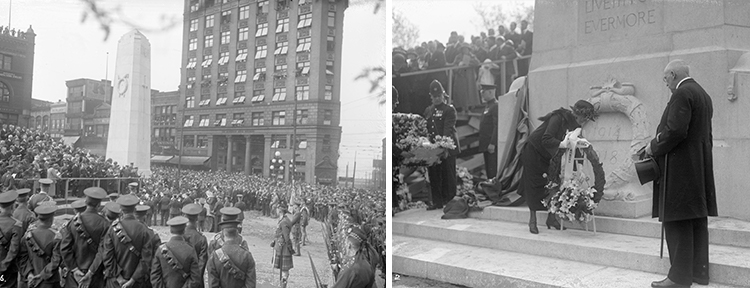
The letters did not appear to impact the plans already in motion. After the City received the authority from the Provincial Government (which owned Victory Square) in September 1923, construction began, and the Cenotaph was unveiled on April 27, 1924.
*****************************************************************************
Endnotes
[1] City Council minutes, Oct 14, 1919, p. 633, COV-S31
[2] Report on Vancouver War Memorial Project, Oct 31, 1921, p. 29, AM95
[3] Report on Vancouver War Memorial Project, Oct 31, 1921, p. 29-30, AM95
[4] Council minutes, February 13, 1922, p. 682, COV-S31
[5] Board of Works minutes, February 7, 1922, p. 128-129, COV-S373
[6] Council minutes, March 13, 1922, p. 715, COV-S31
[7] The Vancouver Sun, March 11, 1922
[8] The Vancouver Sun, March 11, 1922
[9] This was reported in the Vancouver Sun, March 11, 1922, as well as an oral report given on March 13, 1922, by Mr. Fyfe-Smith to the Exec at the Canadian Club that opposition was mounting from the public.
[10] Canadian Club minutes, Nov 7, 1922, p. 123-124, AM95
[11] Council minutes, Nov. 8, 1922, COV-S31, Vol. 24, p. 171
[12] The Vancouver Sun, February 16, 1923
[13] Executive Committee of Vancouver War Memorial Fund minutes, Mar. 12, 1923, AM95, 511-C-01 fld 05
[14] J.G. Barringer letter to the editor, Vancouver Sun, March 20, 1923. According to the city directories, J.G. Barringer was the manager of Holbrooks, Ltd. (pickle manufacturer located at 1006 Mainland)
[15] AIBC letter to the editor, Vancouver Sun, March 23, 1923