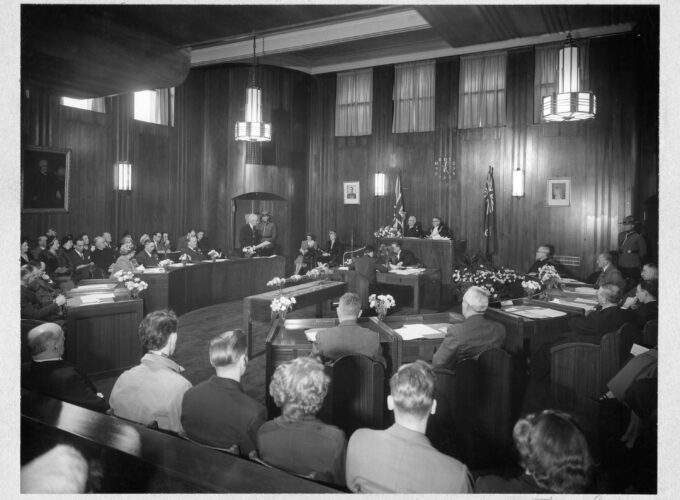
Earlier this year, Harry Swain of Victoria donated a photograph to us and it caused great excitement. Here it is:
My summer internship at the City of Vancouver Archives was filled with wonderful experiences along with the occasional adventure, so much so that it has taken me a while to catch my breath and finally write about it. As a student in the Master of Art Conservation program at Queen’s University, the Archives fostered an ideal learning environment for a conservator-in-training to reinforce the skills acquired through the past academic year. I was fortunate to learn from not one but two experienced conservators. Working under the supervision of Sue Bigelow and Rosaleen Hill, the Digital Conservators at the Archives, I had the privilege of taking in a double dose of valuable knowledge.

The Award of Merit 1943, one of the many spectacular works of art found in the Archives. This image consists of merged photographs of the parchment before (left) and after (right). treatment.
Comments Off
Tagged conservation, documentary art, parchment, photographs, Students
When we first told you about our new search system, we said that it was on a rapid development cycle and that there would be improvements. We’re pleased to tell you about one upgrade that gives you on-site access to thousands more digital objects and another that makes it easier to do research at home. Developed for us by Artefactual Systems, these open source enhancements could be adapted by other institutions using the same database software.
Until now, digital objects that were under the copyright of a 3rd party (other than City of Vancouver’s copyright) could only be viewed online as a tiny thumbnail. Now they can be viewed in full resolution in our Reading Room through our online search. This works on your laptop in the Reading Room (using our wifi) as well as at our public computers. Continue reading
Fourth in a series about the BC Sugar records

Three laboratory staff members in 1916: Maggie McKenzie, Ernie Abbott and R.B. Reference code: 2011-092.1854.
The science of sugar! The refining of sugarcane or sugar beets to make the sugar products that we all know and love requires expertise and scientific precision. The science carried out at BC Sugar is well reflected in the records that were donated to the City of Vancouver Archives. I would like to share with you some of the records that show the science and scientists that worked at the company. Continue reading
Kaitlin Haley began volunteering at the Archives in the summer of 2012. After completing a Bachelor of Arts degree at UBC in history and political science in 2010, she worked as a flight attendant, taking a break from school and deciding on a graduate studies program. An interest in archives and libraries lead her to us. Like many of our other volunteers, Kaitlin has given of her time generously elsewhere including lifeguarding for the World Police and Firefighter Games, running activities at the Musqueam Reading Club and facilitating and helping to organize events for the Beauty Night Society.
After being accepted to several archival and library schools across Canada, Kaitlin chose the program farthest from this coast, Halifax. She will be earning a Master of Library and Information Studies at Dalhousie starting in 2014. Her choice to defer for a year will allow her to continue working for the UN as a flight attendant. Between stints in Africa, which she is currently visiting, we hope Kaitlin will find some down time to visit us before she goes jetting off again! Continue reading
Posted in General, Holdings, People, Preservation
Tagged glass plate negatives, Volunteers
We will be closed for the four-day Easter weekend. See you again in April!
This little gem was sent to Elsie from her husband Ted sometime between 1914 and 1918. This embroidered postcard belongs to a type known as “silks,” which were made in France and bought by Allied soldiers during the First World War.
It appears that people have always taken photos of their cats to share; it’s not just a Web obsession. Here are a few that made their way into the Archives–feel free to download the images and superimpose your own captions.
This is a formal studio portrait of a three-year-old boy. Perhaps the cat helped to calm him and keep him still, although at this early date the child might have been tied to the chair or held in a clamp.
One hundred years ago, on March 7, 1913, Emily Pauline Johnson died in Vancouver. She retired here in 1909 as a celebrated poet, author and performer and, although Johnson lived a brief four years in Vancouver, she left a lasting legacy in the city.

Portrait of E. Pauline Johnson, undated. George T. Wadds, photographer. Reference code AM54-S4-: Port P637
Born in 1861 on the Six Nations Reserve, outside Brantford, Canada West (Ontario), Pauline Johnson was the daughter of a Mohawk chief and an English mother. Her Mohawk name was Tekahionwake. She published her first poem in 1884. In 1892 she began to read her poems to audiences, honing her skill as a dramatic performer as she performed on tours across Canada, in the United States and in England over the next 17 years. Her first book of poems, The White Wampum, was published in 1895. Continue reading
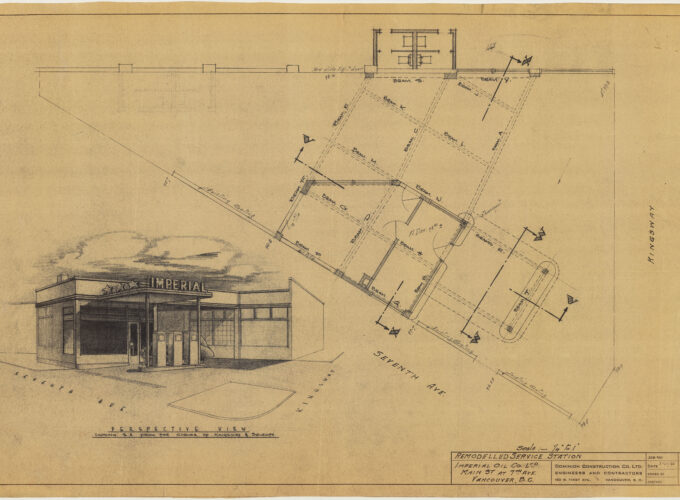
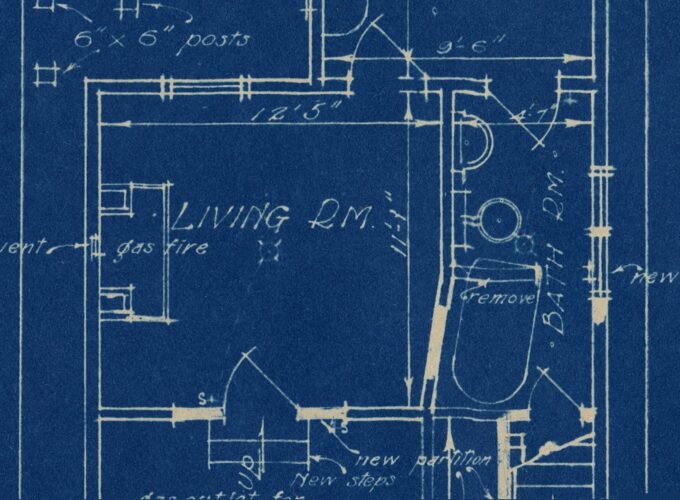
Thanks to funding from the British Columbia History Digitization Program, we’ve completed a project to digitize 512 maps and plans in our holdings. Here are some highlights from the project. We’ve provided links to descriptions in our database so you can click through to the full-resolution versions of the maps if you’d like to examine them in detail. Here’s the link for the map below.
The project makes these maps available to everyone quickly online, and makes them easy to re-use. It reduces damage to the oversized originals due to handling, as they no longer have to be retrieved from storage. Very light-sensitive materials, like blueprints, may be kept in the dark so they don’t fade. Continue reading
January 26 is Australia Day, Australia’s national day. We have records that show some of Vancouver’s interactions with Australia and Australians. Here are a few examples.
The Young Australia League is a youth organization founded in 1905 that promotes “education through travel”, among other activities. They stopped in Vancouver during their 1929 overseas tour, along with a burro they picked up in their travels.

Members of the Young Australia League with burro, May 1929. Stuart Thomson, photographer. Reference code AM1535-: CVA 99-2027